

Men’s Grooming Products encompass a wide range of personal care items specifically formulated and marketed toward male consumers, including skincare, hair care, beard care, shaving essentials, fragrances, body care, and styling products. This market focuses on addressing male-specific needs such as oilier skin, coarser facial hair, frequent shaving irritation, and preferences for straightforward, functional, and masculine-branded formulations. The sector has evolved from basic soaps and aftershaves to sophisticated, science-backed solutions featuring natural ingredients, anti-aging actives, sustainable packaging, and multi-functional products that combine cleansing, moisturizing, and protection in one step, reflecting shifting cultural attitudes toward male self-care, appearance, and wellness.

Key Insights
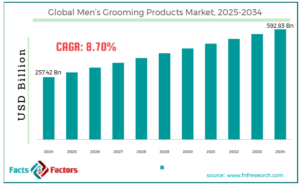
- As per the analysis shared by our research analyst, the Men’s Grooming Products Market is poised to grow at a CAGR of 6.2% from 2026 to 2034.
- In terms of revenue, the Global Men’s Grooming Products Market size was valued at USD 78.5 billion in 2026 and is expected to reach USD 126.8 billion in 2034.
- The market is driven by increasing male focus on personal appearance, rising e-commerce penetration, and premiumization trends.
- Based on the Product Type segment, Skin Care dominated the market with a revenue share of 32% in 2026. This dominance stems from growing awareness of skin health, anti-aging concerns, and the introduction of male-specific cleansers, moisturizers, and serums.
- Based on the Distribution Channel segment, Online Retail dominated the market with a revenue share of 38% in 2026. Online retail leads due to convenience, wide product assortment, subscription models, and influencer-driven purchases.
- Based on the End-user segment, Individual Consumers dominated the market with a revenue share of 82% in 2026. Individual consumers prevail owing to the shift toward daily grooming routines and self-care among millennials and Gen Z men.
- North America dominated the market with a revenue share of 34% in 2026. This leadership is attributed to high disposable income, strong brand loyalty, advanced e-commerce infrastructure, and cultural acceptance of male grooming.
Growth Drivers
- Changing Male Grooming Attitudes
Societal normalization of male self-care, fueled by social media, celebrity endorsements, and influencer culture, has removed stigma around men using skincare and styling products. This cultural shift encourages daily routines beyond basic hygiene.
Additionally, workplace appearance standards and dating culture have made grooming a competitive advantage, prompting younger demographics to invest in premium and functional products.
Restraints
- Price Sensitivity in Emerging Markets
High-end grooming products remain aspirational in price-sensitive regions, limiting penetration among middle- and lower-income groups despite rising awareness.
Additionally, counterfeit products and low-quality imitations erode trust and dilute brand value in developing economies.
<<< Read More Articles – https://fnfnewsblog.com/3018/tumor-infiltrating-lymphocyte-til-therapy-market >>>
Opportunities
- Expansion into Underserved Categories
Beard care, scalp health, intimate grooming, and men’s makeup (concealers, brow gels) remain underdeveloped, offering white-space opportunities for innovation and category creation.
In parallel, functional products addressing specific concerns like acne, hyperpigmentation, and post-shave sensitivity can capture loyal niche segments.
Challenges
- Intense Competition and Brand Saturation
The influx of new DTC brands and line extensions from legacy players creates crowded shelves and digital feeds, making differentiation increasingly difficult.
Additionally, rapid trend cycles demand constant innovation, straining R&D budgets and risking product cannibalization.
Market Segmentation
The Men’s Grooming Products market is segmented by product type, distribution channel, end-user, and region.
Based on Product Type Segment
The Men’s Grooming Products market is divided into skin care, hair care, beard & shaving care, fragrances, body care, and others.
The most dominant subsegment is skin care, leading due to heightened awareness of UV damage, pollution effects, and anti-aging among men, driving demand for cleansers, moisturizers, and serums. The second most dominant is beard & shaving care, fueled by the beard renaissance and post-shave irritation solutions. Skin care propels the market through premiumization and daily-use habits, while beard & shaving care expands it via specialized tools and balms, together creating cross-selling opportunities and reinforcing grooming as an essential routine.
Based on the Distribution Channel Segment
The Men’s Grooming Products market is divided into online retail, specialty stores, supermarkets/hypermarkets, pharmacies/drugstores, and others.
The most dominant subsegment is online retail, prevailing because of 24/7 accessibility, detailed product information, user reviews, subscription convenience, and targeted digital advertising. The second most dominant is specialty stores, offering expert advice and product trials. Online retail accelerates market growth through global reach and personalization, whereas specialty stores build trust via experiential retail, both crucial for educating consumers and driving premium conversions.
Based on the End-user Segment
The Men’s Grooming Products market is divided into individual consumers, salons & barbershops, and others.
The most dominant subsegment is individual consumers, commanding the lead through the rise of at-home grooming routines and self-purchase behavior among younger men. The second most dominant is salons & barbershops, serving as product discovery and recommendation hubs. Individual consumers drive the market via repeat purchases and social sharing, while salons & barbershops contribute through professional endorsements, collectively expanding category penetration and brand credibility.
Recent Developments
- In January 2026, The Ordinary launched its first men ’s-targeted skincare line featuring simplified, high-potency actives like niacinamide 10% + zinc and salicylic acid 2%, gaining rapid traction through TikTok virality.
- In November 2025, Bevel (by Procter & Gamble) introduced a sustainable refillable shaving system with bamboo handles and recyclable blades, aligning with eco-conscious male consumers and achieving 40% sales growth in Q4.
- In September 2025, Harry’s expanded into scalp care with a clinically tested anti-dandruff and hair thickening shampoo line, backed by dermatologist endorsements and sold exclusively via subscription.
- In July 2025, Lumin expanded its men’s skincare portfolio with blue-light protection moisturizers and eye creams, targeting remote-working professionals and digital screen exposure concerns.
Regional Analysis
- North America to dominate the global market
North America leads the global market through its mature grooming culture, high per-capita spending, and strong DTC ecosystem, with the United States as the dominating country featuring iconic brands and influencer-driven trends from Los Angeles to New York. The region’s advanced e-commerce infrastructure and subscription models accelerate trial and loyalty, while premium positioning resonates with affluent urban consumers. Cultural acceptance of male vanity, reinforced by sports and entertainment figures, normalizes multi-step routines. Retail innovation, including barbershop partnerships and experiential pop-ups, keeps the market dynamic and trend-responsive.
Competitive Analysis
The global Men’s Grooming Products market is dominated by players:
- Procter & Gamble
- Unilever
- L’Oréal Groupe
- Beiersdorf AG
- The Estée Lauder Companies
- Edgewell Personal Care
- Harry’s Inc.
- Dollar Shave Club
- Bevel
- Lumin
The global Men’s Grooming Products market is segmented as follows:
By Product Type
- Skin Care
- Hair Care
- Beard & Shaving Care
- Fragrances
- Body Care
- Others
By Distribution Channel
- Online Retail
- Specialty Stores
- Supermarkets/Hypermarkets
- Pharmacies/Drugstores
- Others
By End-user
- Individual Consumers
- Salons & Barbershops
- Others
By Region
- North America
- Europe
- Asia-Pacific
- Latin America
- Middle East and Africa