Molten Salt Thermal Energy Storage: Revolutionizing the Energy Landscape
The global push toward sustainable and reliable energy solutions has fueled the rapid evolution of energy storage technologies. Among these, Molten Salt Thermal Energy Storage (TES) has emerged as a promising solution, offering a pathway to enhance the efficiency, reliability, and sustainability of energy systems. As energy demands surge and renewable energy penetration increases, understanding the role and impact of molten salt TES becomes critical. This article provides a comprehensive overview, examining the technology, its applications, market dynamics, trends, consumer preferences, innovations, and sustainability aspects.
Definition of Molten Salt Thermal Energy Storage
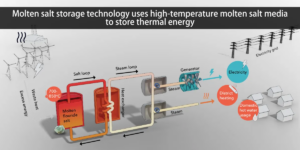
Molten Salt Thermal Energy Storage is a method of storing thermal energy by utilizing molten salts as a medium to absorb, retain, and release heat. This process involves heating the salts to high temperatures until they become molten, storing the thermal energy, and then using the heat for electricity generation, industrial processes, or other applications. The salts typically consist of a mixture of sodium nitrate and potassium nitrate, although other compositions may be used depending on the operational temperature and specific applications.
TES systems using molten salts operate on the principle of storing energy as sensible heat, where the salts’ temperature changes during charging and discharging cycles without undergoing a phase change. The high specific heat capacity of molten salts allows them to store large amounts of energy efficiently, making them suitable for applications requiring steady and controllable thermal output.
Key Insights into Molten Salt TES
Molten salt TES has garnered attention due to several key advantages that make it a vital component of modern energy infrastructure:
-
High Energy Density: Molten salts can store significant amounts of energy in a relatively compact space, allowing for efficient thermal energy storage and delivery.
-
Cost-Effectiveness: Compared to other energy storage technologies, molten salt TES systems can provide economical solutions for large-scale storage, particularly in solar power plants.
-
Flexibility in Operation: The technology supports both short-term and long-term energy storage, enabling grid stability during peak demand and enhancing the utilization of renewable energy sources.
-
Integration with Renewable Energy: Molten salt TES complements solar thermal power generation by storing excess heat during the day and releasing it at night, ensuring a continuous power supply.
-
Scalability: These systems can be scaled up for industrial applications or down for smaller commercial energy storage solutions, offering versatility across sectors.
Technology Use
Molten salt TES technology primarily finds applications in concentrated solar power (CSP) plants, where it plays a crucial role in bridging the gap between energy generation and demand. The system generally comprises the following components:
-
Heat Collection System: Mirrors or heliostats concentrate sunlight onto a receiver, heating a heat transfer fluid, often synthetic oil, which then transfers the heat to molten salts.
-
Storage Tanks: Two main tanks—hot and cold—store the molten salt at different temperatures. Heat is transferred to the hot tank during energy capture and extracted from it during energy discharge.
-
Heat Exchangers: These facilitate the transfer of stored heat from molten salts to water or other working fluids, which then drive turbines for electricity generation.
-
Control Systems: Advanced control systems monitor temperatures, flow rates, and thermal performance to optimize efficiency and ensure safety.
Beyond CSP plants, molten salt TES is also being explored in industrial heating applications, including chemical processing, steel manufacturing, and district heating systems, due to its high-temperature stability and reliability.
Current Trends in Molten Salt TES
The molten salt TES market is experiencing significant momentum due to multiple trends:
-
Rising Solar Energy Deployment: As solar power projects expand globally, integrating molten salt TES ensures energy availability during periods without sunlight.
-
Hybrid Systems: Combining TES with photovoltaic and wind systems allows for a more flexible and reliable renewable energy supply.
-
Innovations in Salt Compositions: Research into alternative salt mixtures aims to achieve higher thermal stability, lower melting points, and improved energy density.
-
Government Incentives: Many regions are supporting TES deployment through subsidies, tax incentives, and renewable energy mandates, accelerating market adoption.
-
Decentralized Energy Storage: Smaller, localized TES systems are emerging to support industrial facilities and commercial buildings, reducing reliance on centralized power grids.
Competitive Landscape
The molten salt TES market is marked by competition among technology providers, CSP developers, and research institutions. Key players focus on enhancing storage efficiency, reducing costs, and extending system lifespans. Collaboration with utility companies and renewable energy developers is common to integrate TES solutions into existing infrastructure.
Companies in the competitive landscape emphasize:
-
Technology Licensing: Sharing TES designs and proprietary salt mixtures for global adoption.
-
Strategic Partnerships: Collaborations between energy developers and storage technology providers to create turnkey solutions.
-
Research and Development: Continuous innovation to improve salt formulations, storage tank designs, and thermal efficiency.
-
Project Deployment: Executing large-scale CSP projects with integrated TES to showcase operational success and scalability.
The competitive drive focuses on achieving a lower levelized cost of electricity (LCOE) and maximizing the efficiency of energy storage systems.
Consumer Preferences
Consumers and end-users of molten salt TES include utility companies, industrial operators, and governments seeking reliable, sustainable, and cost-effective energy solutions. Key preferences influencing adoption include:
-
Reliability: Users prioritize systems that deliver consistent energy output during peak and off-peak periods.
-
Longevity: Durability of storage tanks and salts is critical to reduce maintenance costs and maximize operational life.
-
Scalability: Solutions that can be adapted to varying energy demands are preferred by both industrial and municipal consumers.
-
Environmental Impact: Eco-conscious consumers favor TES systems that minimize greenhouse gas emissions and utilize non-toxic materials.
-
Integration Capability: The ability to integrate with renewable energy sources and existing power infrastructure is highly valued.
Technological Innovations
Molten salt TES continues to evolve through technological advancements aimed at improving efficiency, safety, and operational flexibility:
-
Advanced Salt Compositions: Developing salts with lower freezing points and higher thermal conductivity to enhance storage capacity and reduce operational risks.
-
High-Temperature TES: Exploring TES systems that can operate at temperatures exceeding 600°C for increased efficiency in power generation.
-
Modular Tank Designs: Implementing modular storage tanks for easier installation, maintenance, and scalability.
-
Integrated Heat Recovery: Utilizing TES for waste heat recovery in industrial applications, further boosting energy efficiency.
-
Automation and Smart Controls: Implementing AI-driven monitoring systems to optimize thermal performance, predict maintenance needs, and enhance safety.
Sustainability Trends
Molten salt TES aligns with sustainability goals by supporting renewable energy integration and reducing dependence on fossil fuels. Key sustainability trends include:
-
Decarbonization: TES contributes to lower carbon emissions by enabling reliable renewable energy use.
-
Resource Efficiency: Utilizing molten salts made from abundant and non-toxic materials ensures environmental compatibility.
-
Energy Equity: By storing excess energy, TES enables a consistent power supply, contributing to energy access in underserved regions.
-
Circular Energy Use: TES facilitates energy recycling by capturing and storing industrial waste heat.
-
Long-Term Viability: The durability of molten salts and storage systems ensures minimal environmental footprint over extended operational lifetimes.
Challenges and Opportunities
Despite its potential, molten salt TES faces several challenges:
-
High Initial Capital Costs: Large-scale TES systems require significant upfront investment in tanks, salts, and heat exchangers.
-
Thermal Losses: Heat loss during storage and transfer can reduce overall efficiency if not properly managed.
-
Material Degradation: Prolonged exposure to high temperatures may degrade salts or tank materials, necessitating advanced material solutions.
-
Geographical Limitations: Optimal TES operation is often linked to solar availability or industrial heat sources, which may limit deployment in certain regions.
However, these challenges also present opportunities:
-
Research-Driven Innovation: Developing new salt mixtures, high-temperature materials, and efficient heat exchangers.
-
Hybrid Energy Solutions: Integrating TES with other storage and generation systems for optimized energy management.
-
Policy Support: Governments can enhance adoption through incentives, subsidies, and renewable energy mandates.
Future Outlook
The future of molten salt TES looks promising, driven by the global transition to renewable energy, technological innovation, and increasing energy storage demand. Its role in supporting grid stability, industrial efficiency, and decarbonization positions it as a key player in the energy landscape. Continued research, public-private partnerships, and policy support will likely accelerate deployment and expand applications beyond CSP plants into industrial, commercial, and district energy systems.
As molten salt TES matures, the integration of AI, advanced materials, and hybrid energy solutions will redefine energy storage paradigms, making clean, reliable, and sustainable energy more accessible worldwide.
Conclusion
Molten salt thermal energy storage is not merely a technological solution; it is a strategic enabler of sustainable energy systems. With its high energy density, operational flexibility, and compatibility with renewable energy, TES addresses the pressing global need for reliable and eco-friendly energy solutions. While challenges persist in terms of cost, material durability, and thermal efficiency, the ongoing technological innovations, market growth, and sustainability trends suggest a robust and transformative future. As energy systems evolve, molten salt TES is set to play a central role in shaping a cleaner, more resilient energy future.
Read More:
https://www.linkedin.com/pulse/cervical-dysplasia-market-industry-insights-growth-forecast-wsmdf
https://www.linkedin.com/pulse/fatty-alcohol-market-outlook-demand-applications-forecast-qxzbf
https://www.linkedin.com/pulse/global-gluten-free-products-market-analysis-trends-forecast-1yrbf
https://www.linkedin.com/pulse/remote-patient-monitoring-devices-market-industry-insights-6f8af
https://www.linkedin.com/pulse/syngas-derivatives-market-industry-insights-forecast-98xzc
https://www.youtube.com/watch?v=QZudOoTV_Ro
https://www.zionmarketresearch.com/report/india-data-center-market
https://www.zionmarketresearch.com/report/functional-service-providers-market
https://www.zionmarketresearch.com/report/unified-communications-as-a-service-ucaas-market
https://www.zionmarketresearch.com/report/north-america-third-party-logistics-market