Secure Microcontroller Market Size & Share | Forecast [Latest]
Market Overview
A secure microcontroller is a specialized integrated circuit that combines processing capabilities with built-in hardware security measures, such as cryptographic engines, secure boot mechanisms, and tamper-resistant memory, to protect sensitive data and processes in embedded systems. This market tackles the important need to protect against unauthorized access, side-channel attacks, and firmware vulnerabilities in an increasingly interconnected world, with applications ranging from payment terminals and smart cards to IoT devices and automobile controls. Secure microcontrollers enable robust authentication, encryption, and integrity verification by embedding trusted execution environments and random number generators. This fosters innovation in secure-by-design architectures while navigating evolving standards like FIPS and Common Criteria to ensure compliance and resilience across diverse industries.
Key Insights
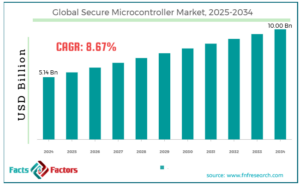
- As per the analysis shared by our research analyst, the Secure Microcontroller Market is poised to grow at a CAGR of 12.5% from 2026 to 2034.
- In terms of revenue, the Global Secure Microcontroller Market size was valued at USD 31 Billion in 2026 and is expected to reach USD 80.7 billion in 2034.
- The market is driven by escalating cybersecurity threats and the proliferation of IoT devices.
- Based on the Type segment, 32-bit dominated the market with a revenue share of 50% in 2026. This dominance is due to its superior processing power and scalability, making it ideal for complex applications requiring advanced encryption and real-time data handling.
- Based on the Application segment, Consumer Electronics dominated the market with a revenue share of 40% in 2026. Consumer electronics lead owing to the high volume of connected devices like smartphones and wearables that demand embedded security for user data protection.
- Asia Pacific dominated the market with a revenue share of 40% in 2026. This leadership is attributed to massive semiconductor manufacturing hubs and the rapid adoption of secure tech in consumer and industrial sectors.
Growth Drivers
- Rising Cybersecurity Imperatives
The rise in data breaches and ransomware targeting embedded systems has increased demand for hardware-based security, with secure microcontrollers providing immutable defenses at the silicon level. This is especially important in sectors like finance and healthcare, where noncompliance carries significant consequences.
Furthermore, incorporating AI-driven threat detection into these chips improves proactive responses, reduces vulnerability windows, and appeals to developers developing robust ecosystems.
Restraints
- High Development and Integration Costs
The complexity of implementing security measures raises chip design costs and certification schedules, burdening smaller companies and slowing time-to-market. This financial barrier impedes experimentation in cost-sensitive applications.
Furthermore, interoperability concerns with legacy systems need custom changes, which increase overall project costs and hinder migration paths.
Opportunities
- Advancements in Post-Quantum Cryptography
Emerging quantum risks create opportunities for next-generation secure microcontrollers with resistant algorithms, enticing the defense and communications sectors. This prepares early innovators for premium market share.
In addition, open-source security frameworks can democratize access, encouraging collaborative development and lowering entry hurdles for entrepreneurs.
Challenges
- Balancing Security with Performance
Optimizing for both effective protection and efficient computation remains difficult, as more security layers might cause latency or power drain in resource-constrained systems. This tradeoff complicates optimization.
Furthermore, developing attack routes necessitates frequent firmware updates, making over-the-air techniques difficult to implement in bandwidth-constrained settings.
Market Segmentation
The Secure Microcontroller market is segmented by type, application, end-user, and region.
Based on Type Segment, the Secure Microcontroller market is classified into four segments: 8-bit, 16-bit, 32-bit, and others. The most popular subsegment is 32-bit, which is due to its superior processing capability and support for sophisticated cryptographic protocols required by modern connected devices. The second most popular is 16-bit, which provides a balance of efficiency and security for mid-range applications. 32-bit variants drive the market by enabling high-performance secure processing in the AIoT and automotive domains, while 16-bit variants contribute by providing cost-effective solutions for legacy upgrades, accelerating adoption by addressing a wide range of performance-security requirements and increasing ecosystem compatibility.
Based on Application Segment, the Secure Microcontroller market is segmented into consumer electronics, automotive, industrial, smart cards, payment systems, and others. Consumer electronics is the most dominant subsegment, owing to widespread adoption of personal devices that require flawless data encryption and authentication. The second most dominant is automotive, which focuses on vehicle-to-everything connection. Consumer electronics drives development through volume-driven breakthroughs in wearables and smart homes, while automotive expands it through safety-essential integrations, which are critical for protecting user privacy and enabling secure digital transitions.
Based on End-user Segment, the Secure Microcontroller market is segmented into automotive, consumer electronics, industrial automation, healthcare, aerospace and defense, and others. Automotive is the most popular subsegment, driven by demand for tamper-proof ECUs as connected automobile technologies become more prevalent. Consumer electronics is the second most dominating category, driven by endpoint security in everyday gadgets. Automotive drives the industry with regulatory-mandated cyber resilience enhancements, while consumer electronics expands reach with low-cost secure chips, all of which improve supply chain trust and innovation velocity.
Recent Developments
- In February 2026, Infineon Technologies unveiled its next-generation AURIX TC4x secure microcontroller family at Embedded World, featuring enhanced post-quantum cryptography support and integrated HSM for automotive ADAS applications, aiming to bolster zero-trust architectures.
- In December 2025, NXP Semiconductors expanded its MCX N series with new secure boot and edge AI capabilities, targeting industrial IoT gateways and achieving Common Criteria EAL6+ certification for high-assurance deployments.
- In August 2025, STMicroelectronics launched the STM32H7R/S secure microcontroller lineup, incorporating Arm TrustZone and advanced RNG for consumer wearables, reducing power consumption by 20% while maintaining robust side-channel resistance.
- In May 2025, Renesas Electronics introduced the RA8E1 secure MCU with RISC-V core options, focusing on flexible licensing for smart card and payment terminals, partnering with Visa for accelerated EMV compliance testing.
<<< Read More Articles – https://fnfnewsblog.com/3007/diy-eyelash-market >>>
Regional Analysis
- Asia Pacific to dominate the global market
Asia Pacific dominates the global market through its unparalleled semiconductor fabrication ecosystem and explosive demand from consumer tech giants, with China as the dominating country leveraging state investments in domestic chip security for 5G and smart cities. The region’s supply chain dominance facilitates rapid prototyping and cost optimizations, integrating secure microcontrollers into everything from EVs to surveillance systems. Export policies and talent pools in Taiwan and South Korea further amplify production scales, while initiatives like Made in China 2025 prioritize indigenous security tech to mitigate geopolitical risks.
Competitive Analysis
The global Secure Microcontroller market is dominated by players:
- Infineon Technologies AG
- NXP Semiconductors N.V.
- STMicroelectronics N.V.
- Renesas Electronics Corporation
- Microchip Technology Inc.
- Texas Instruments Incorporated
- Analog Devices, Inc.
- Broadcom Inc.
- Samsung Electronics Co., Ltd.
- Advanced Micro Devices, Inc.
The global Secure Microcontroller market is segmented as follows:
By Type
- 8-bit
- 16-bit
- 32-bit
- Others
By Application
- Consumer Electronics
- Automotive
- Industrial
- Smart Cards
- Payment Systems
- Others
By End-user
- Automotive
- Consumer Electronics
- Industrial Automation
- Healthcare
- Aerospace & Defense
- Others
By Region
- North America
- Europe
- Asia Pacific
- Latin America
- Middle East and Africa
Frequently Asked Questions
What is Secure Microcontroller?
Secure Microcontroller is an embedded processor with integrated hardware security features like encryption engines and tamper detection to protect against cyber threats in devices ranging from smart cards to IoT sensors.
What are the key growth drivers of the Secure Microcontroller Market?
Key drivers include intensifying cyber risks in connected ecosystems, regulatory demands for data protection, and the boom in IoT and automotive electronics requiring trusted computing bases.
What will be the value of the Secure Microcontroller market during 2026-2034? (add both values)
The market is projected to grow from USD 31 billion in 2026 to USD 80.7 billion in 2034.
What will be the CAGR value of the Secure Microcontroller market during 2026-2034? (full answers)
The CAGR is expected to be 12.5% during 2026-2034, propelled by advancements in edge security and global digitization trends.
Which are the major players leveraging the Secure Microcontroller market growth?
Major players include Infineon Technologies AG, NXP Semiconductors N.V., STMicroelectronics N.V., Renesas Electronics Corporation, and Microchip Technology Inc.
What can be expected from the global Secure Microcontroller market report?
The report offers exhaustive coverage of market trends, segmentation insights, competitive evaluations, regional dynamics, and strategic forecasts to guide investment and operational decisions.