Drum Motor Market Size | Industry Insights & Growth Forecast 2026–2034
Market Overview
A drum motor is an enclosed motorized pulley system in which an electric motor, gearbox, and bearings are integrated within a cylindrical drum to serve as a driving unit for conveyor belts and material handling equipment. This small design eliminates extraneous components, which improves productivity, hygiene, and space utilization in industrial applications like logistics, food processing, and manufacturing. The market includes the manufacturing, distribution, and innovation of these self-contained devices, with an emphasis on durability, energy efficiency, and seamless integration into automated systems to expedite operations and decrease maintenance requirements.
Key Insights
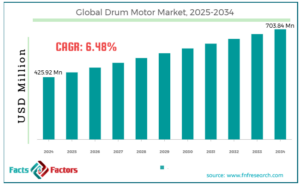
- As per the analysis shared by our research analyst, the Drum Motor Market is poised to grow at a CAGR of 4.5% from 2026 to 2034.
- In terms of revenue, the Global Drum Motor Market size was valued at USD 2.09 billion in 2026 and is expected to reach USD 2.97 billion in 2034.
- The market is driven by increasing industrial automation and the expansion of e-commerce logistics.
- Based on the Motor Type segment, Asynchronous Motors dominated the market with a revenue share of 55% in 2026. This dominance arises from their cost-effectiveness, reliability in continuous operations, and widespread compatibility with standard conveyor systems.
- Based on the Application segment, Conveying Systems dominated the market with a revenue share of 40% in 2026. Conveying systems lead due to their essential role in material handling across industries, driving efficiency in high-volume production and distribution environments.
- Based on the End-user segment, Manufacturing dominated the market with a revenue share of 42% in 2026. Manufacturing prevails because of the need for robust, low-maintenance drive solutions in automated assembly lines and heavy-duty operations.
- Asia Pacific dominated the market with a revenue share of 43% in 2026. This leadership is due to rapid industrialization, booming e-commerce, and significant investments in manufacturing infrastructure in the region.
Growth Drivers
- Industrial Automation Adoption
The increase in automation in the manufacturing and logistics industries drives demand for drum motors, which provide smooth integration with robotic systems and conveyor networks. This trend is driven by the desire for increased productivity and lower labor costs in competitive global marketplaces.
Furthermore, improvements in Industry 4.0 technologies, such as IoT-enabled monitoring, improve drum motor performance, allowing for predictive maintenance and real-time efficiency optimization, speeding up their adoption in smart factories.
- E-commerce and Logistics Expansion
The fast rise of online retail needs efficient storage and sorting systems, and drum motors offer small, hygienic solutions for high-speed parcel handling. This driver is fueled by consumer desire for speedier delivery times.
Furthermore, investments in emerging economies’ supply chain infrastructure facilitate the integration of drum motors, increasing throughput and lowering operational downtime in distribution centers.
- Energy Efficiency and Sustainability Focus
Regulatory efforts to reduce energy usage encourage the shift to drum motors, which are more efficient than typical external drives by reducing power losses. This is consistent with business sustainability aims.
Furthermore, the compact design saves material usage and waste, making it desirable to enterprises seeking green certifications and cost savings throughout the product’s lifecycle.
Restraints
- High Initial Investment Costs
Drum motors are more expensive than traditional motor-gearbox combinations, which limits usage among small and medium-sized businesses with limited budgets. This financial barrier impedes market penetration in cost-sensitive sectors.
Furthermore, the necessity for specialized installation and probable retrofitting fees raises the upfront costs, discouraging upgrades to existing systems.
<<< Read More Articles – https://fnfnewsblog.com/2989/aircraft-component-market >>>
- Lack of Standardization
Variations in drum motor specifications between manufacturers make compatibility and interchangeability difficult, providing issues for end users in multi-vendor setups. This fragmentation complicates procurement procedures.
Furthermore, the lack of uniform standards impedes scalability and aftermarket service, reducing trust in the technology for worldwide operations.
Opportunities
- Technological Innovations
Advancements in variable frequency drives and smart sensors provide opportunities for improved drum motor functionality, such as remote diagnostics and adaptive speed control. These advancements entice tech-savvy industries.
Furthermore, R&D collaborations can result in bespoke solutions for specific applications, boosting market reach into industries such as medicine and airports.
- Emerging Market Growth
Industrialization in Asia-Pacific and Latin America provides potential for drum motor producers to access unexplored markets with customized, low-cost versions. Government incentives for automation increase this potential.
Furthermore, increasing awareness of operational efficiency in developing economies promotes adoption, resulting in long-term growth via localized manufacturing and distribution networks.
Challenges
- Supply Chain Disruptions
Global reliance on raw materials and components exposes the sector to geopolitical risks and pandemics, resulting in delays and price swings. This affects delivery timeliness.
Furthermore, skilled labor shortages in production and maintenance compound these issues, compromising product quality and market response.
- Intense Competition
The presence of so many players exacerbates pricing wars and innovation pressures, making it difficult for smaller businesses to compete. This competitive landscape necessitates ongoing differentiation.
Furthermore, counterfeit goods and low-quality imports erode market trust, hampering efforts to uphold standards and brand reputation.
Market Segmentation
The Drum Motor market is segmented by motor type, application, end-user, and region.
Based on the Motor Type Segment, the Drum Motor market is segmented into asynchronous motors, synchronous motors, DC motors, and others. Asynchronous motors are the most popular subsegment because of their low cost, durability, and adaptability for variable speed applications in industrial settings, which reduces energy consumption and operational expenses. Synchronous motors are the second most common type, valued for their accurate control in high-torque circumstances. Asynchronous motors drive the industry by allowing for widespread automation in conveyor systems, while synchronous motors contribute through specific uses in food processing, driving innovation and efficiency benefits across several industries.
Based on Application Segment, the Drum Motor market is segmented into conveying systems, packing and sorting, bottle recycling, X-ray and security scanning systems, pharmaceutical handling systems, and others. Conveying systems are the most important subsegment, due to their critical role in material delivery throughout warehouses and factories, which improves throughput and dependability. The second most important is packaging and sorting, which is necessary for e-commerce fulfillment. Conveying systems drive market expansion by facilitating large-scale logistics operations, whereas packing and sorting applications extend the market by integrating with automated lines, both of which are critical for meeting increased demand for supply chain efficiency and minimizing human labor.
Based on the End-user Segment, the Drum Motor market is segmented into manufacturing, food processing, logistics and warehousing, and others. Manufacturing is the most important subsegment, driven by the demand for long-lasting, maintenance-free drives in production applications to assure continuous operation. Logistics and warehousing is the second most important sector, spurred by the growth of e-commerce. Manufacturing drives the market through the use of assembly lines for precision and cost savings, while logistics and warehousing improve through high-speed sorting capabilities, hence supporting overall market expansion by meeting efficiency and cleanliness requirements in important industries.
Recent Developments
- In July 2024, WEG acquired Regal Rexnord Industrial Motors, expanding its product portfolio and enhancing customer service capabilities across global markets for drum motor applications.
- In June 2025, Conveyor Technology announced a $33 million expansion initiative in Arkansas, aimed at scaling manufacturing, repair, and service capabilities for electric drum motors.
- In 2024, Van der Graaf introduced the GrizzlyDrive Drum Motor, designed for belt conveyors in harsh environments, improving durability and performance in challenging industrial settings.
Regional Analysis
- Asia Pacific to dominate the global market
Asia Pacific dominates the worldwide industry due to its large manufacturing base and growing urbanization, with China leading the way through significant investments in automation and e-commerce infrastructure. Government regulations promoting Industry 4.0, which encourage conveyor technology innovation, are helping to drive the region’s economy. Strong supply chains and cost-competitive production strengthen its position, allowing for effective material handling solutions that serve to a wide range of industries, including electronics and food processing, while also meeting growing expectations for sustainability and operational efficiency.
North America has a considerable stake, driven by enhanced technological adoption and high sanitary requirements, with the United States dominating due to robust logistical networks and e-commerce behemoths. The region’s concentration on automation in warehousing boosts productivity, with manufacturers and technology firms collaborating to accelerate drum motor integration. This emphasis on innovation and regulatory compliance enables consistent performance in high-volume operations, contributing to long-term market stability and growth.
Europe maintains a prominent presence, with a focus on energy-efficient and environmentally friendly solutions, spearheaded by Germany due to its engineering skills and automotive industry demands. The area’s adherence to circular economy principles encourages long-lasting drum motors, which are integrated into sophisticated supply chains. Cross-border commerce and R&D investments help sectors achieve higher levels of safety and efficiency.
Latin America is steadily emerging, influenced by growing industrialization and export-oriented economies, with Brazil dominating in agribusiness and mining applications. Foreign investments have assisted regional attempts to update infrastructure, which includes drum motors for improved handling. This breakthrough addresses logistical issues, increasing competitiveness in global markets while focusing on cost-effective and dependable technology.
The Middle East and Africa are experiencing promising growth as infrastructure investments and resource extraction continue, with the UAE leading the way through diversification into logistics and manufacturing. Investments in smart facilities include drum motors to improve operations in dry regions, with oil earnings subsidizing technical advancements. This progress addresses regional concerns such as supply chain inefficiencies, supporting long-term industrial expansion.
Competitive Analysis
The global Drum Motor market is dominated by players:
- Interroll Group
- Van der Graaf
- Rulmeca Group
- SEW-Eurodrive GmbH & Co. KG
- BEGE Power Transmission
- Boneng Transmission
- Chiorino Group
- CURRAX
- Damon Industry
- Deutronic Elektronik GmbH
The global Drum Motor market is segmented as follows:
By Motor Type
- Asynchronous Motors
- Synchronous Motors
- DC Motors
- Others
By Application
- Conveying Systems
- Packaging & Sorting
- Bottle Recycling
- X-Ray & Security Scanning Systems
- Pharmaceutical Handling Systems
- Others
By End-user
- Manufacturing
- Food Processing
- Logistics & Warehousing
- Others
By Region
- North America
- Europe
- Asia Pacific
- Latin America
- Middle East and Africa
Frequently Asked Questions
What is a Drum Motor?
Drum Motor is a compact, integrated drive system enclosing the motor and gearbox within a cylindrical shell, used primarily to power conveyor belts in industrial settings for efficient material handling.
What are the key growth drivers of the Drum Motor Market?
Key drivers include rising automation in manufacturing, expansion of e-commerce logistics, and demand for energy-efficient, low-maintenance conveyor solutions.
What will be the value of the Drum Motor market during 2026-2034? (add both values)
The market is projected to grow from USD 2.09 billion in 2026 to USD 2.97 billion in 2034.
What will be the CAGR value of the Drum Motor market during 2026-2034? (full answers)
The CAGR is expected to be 4.5% during 2026-2034, supported by industrial automation trends and technological advancements.
Which are the major players leveraging the Drum Motor market growth?
Major players include Interroll Group, Van der Graaf, Rulmeca Group, SEW-Eurodrive GmbH & Co. KG, and BEGE Power Transmission.
What can be expected from the global Drum Motor market report?
The report offers comprehensive insights into market size, trends, segmentation, competitive landscape, regional analysis, and future projections to inform strategic planning.